Neurons and the Cerebral Cortex
Neurons are the brain's information-processing cells, and the cerebral cortex -- a 2-3mm sheet of tissue folded into the skull -- is where the most complex neural computation occurs.
Understanding consciousness at any level of detail requires understanding the hardware it runs on. This article covers the basics: what a neuron does, how neurons communicate, and how roughly 16 billion of them are organized into the cerebral cortex.
The Neuron
A neuron is a cell specialized for electrical and chemical signaling. Its basic structure has three parts:
- Dendrites receive input from other neurons. A single neuron can have thousands of dendritic branches, each receiving signals from a different source.
- Cell body (soma) integrates those inputs. If the combined signal exceeds a threshold, the neuron fires.
- Axon transmits the output signal to other neurons. Axons can be very short (connecting neighbors) or very long (spanning the entire brain).
The firing event is called an action potential -- a brief electrical spike (~1 millisecond) that travels down the axon at speeds up to 120 meters per second. Action potentials are all-or-nothing: a neuron either fires or it does not. There is no "half fire." This binary quality is important -- it means neural computation has a digital character at the single-cell level, even though the network as a whole behaves analogically.
Where one neuron meets another is the synapse -- a tiny gap where the electrical signal is converted to a chemical one. The sending neuron releases neurotransmitters (molecules like glutamate, GABA, dopamine) into the gap. The receiving neuron's receptors detect these molecules and convert the signal back to electrical form. This chemical step is where learning happens: synapses can strengthen or weaken over time, changing which signals get through and how strongly. A single human brain contains approximately 100 trillion synapses.
The Cerebral Cortex
The cerebral cortex is the outer layer of the brain -- the wrinkled, gray surface visible in any brain photograph. Despite being only 2-3mm thick, it contains roughly 16 billion neurons arranged in a remarkably consistent architecture.
Six layers. Nearly all of the cortex (the neocortex, specifically) is organized into six horizontal layers, numbered I (outermost) to VI (innermost). Each layer has a characteristic cell type and connectivity pattern:
| Layer | Primary role |
|---|---|
| I | Mostly dendrites and axons; few cell bodies. Integration zone. |
| II/III | Lateral connections to other cortical areas. The "gossip network" -- cortex talking to cortex. |
| IV | Receives input from the thalamus (sensory relay). Thickest in primary sensory areas. |
| V | Sends output to subcortical structures (motor commands, brainstem). Contains the largest pyramidal neurons. |
| VI | Sends feedback to the thalamus. Closes the thalamo-cortical loop. |
Cortical columns. Perpendicular to the horizontal layers, the cortex is organized into vertical columns roughly 0.5mm in diameter. Each column spans all six layers and functions as a processing unit. In visual cortex, a column might respond to edges at a specific orientation; in somatosensory cortex, to touch on a specific patch of skin. The column is the cortex's repeating functional unit -- like a pixel in a screen, but vastly more complex.
Why This Matters for Consciousness
The six-layer architecture is not decorative. The separation between feedforward input (Layer IV), lateral integration (Layers II/III), and feedback (Layer VI) creates the infrastructure for recurrent processing -- signals flowing not just bottom-up but also top-down and laterally. Many consciousness theories, including proposals about criticality and self-simulation, depend on this recurrent architecture. A purely feedforward system -- signals in, signals out, no loops -- could process information but likely could not sustain the kind of self-referential dynamics that consciousness may require.
The cortex is also the structure most directly associated with the content of conscious experience. Damage to specific cortical areas produces specific losses: damage to visual cortex eliminates visual experience, damage to parietal cortex disrupts spatial awareness, damage to prefrontal cortex alters self-monitoring. The cortex is where the models of world and self are constructed and maintained.
Figure
graph LR
    subgraph Neuron["Single Neuron"]
        D["Dendrites<br/>Receive input"] --> S["Soma<br/>Integrate"]
        S --> A["Axon<br/>Transmit output"]
    end

    A -->|"Synapse<br/>(chemical)"| D2["Next neuron's<br/>dendrites"]

    subgraph Cortex["Cortical Column (6 layers)"]
        L1["Layer I — Integration"]
        L23["Layer II/III — Lateral"]
        L4["Layer IV — Thalamic input"]
        L5["Layer V — Motor output"]
        L6["Layer VI — Thalamic feedback"]
    end

    L4 -->|"feedforward"| L23
    L23 -->|"lateral"| L23
    L23 -->|"feedback"| L6
    L6 -->|"loop"| L4

    style D fill:#3498db,color:#fff
    style S fill:#2ecc71,color:#fff
    style A fill:#e74c3c,color:#fff
    style D2 fill:#3498db,color:#fff
    style L1 fill:#34495e,color:#fff
    style L23 fill:#2c3e50,color:#fff
    style L4 fill:#1a5276,color:#fff
    style L5 fill:#7d3c98,color:#fff
    style L6 fill:#1a5276,color:#fff
Left: the basic neuron — dendrites receive, soma integrates, axon transmits across a synapse to the next cell. Right: a cortical column spanning all six layers, with feedforward, lateral, and feedback connections.
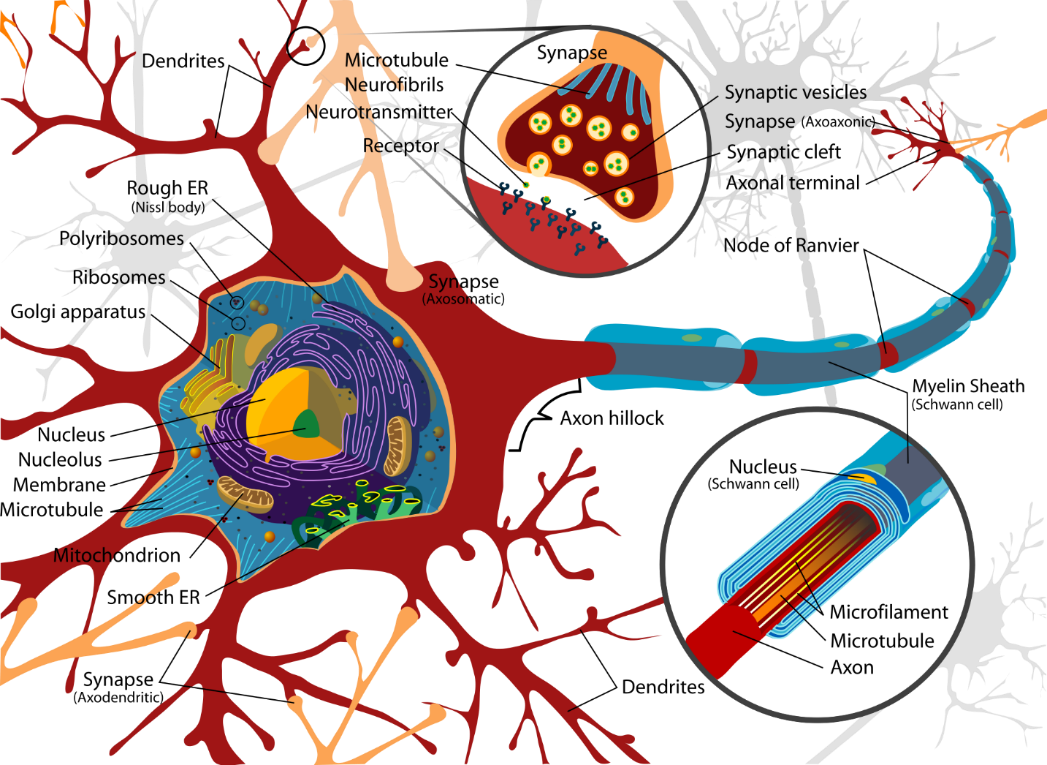
A complete neuron showing the structures described above: dendrites (receiving input), soma (cell body), axon (wrapped in myelin sheath for fast transmission), and three types of synaptic connections — axosomatic (on the cell body), axodendritic (on dendrites), and axoaxonic (on the axon). Insets show the synapse structure (neurotransmitter release across the synaptic cleft) and myelin cross-section. Illustration by Mariana Ruiz Villarreal (public domain).
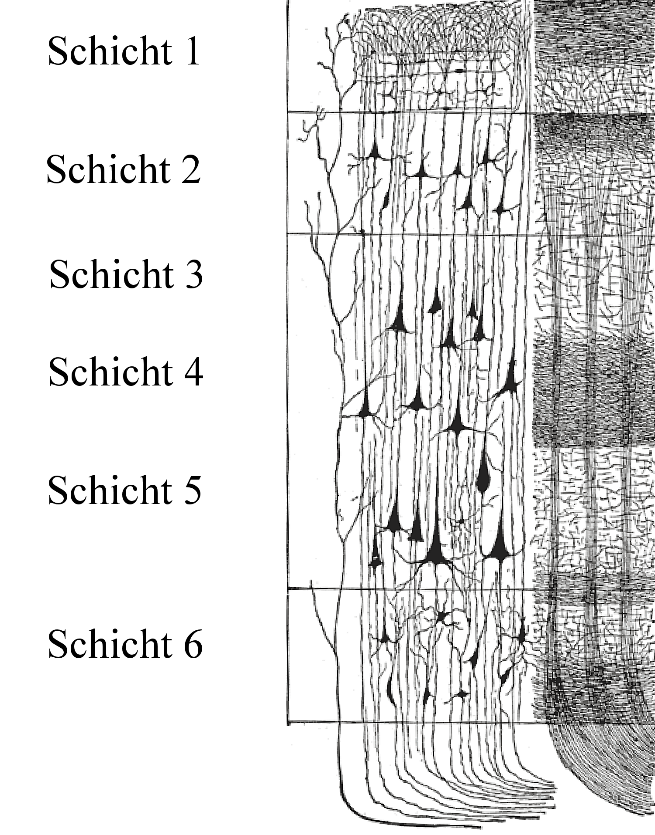
Histological drawing of the six neocortical layers (I-VI). Note the large pyramidal cells in layers III and V, the dense input layer IV, and the varying fiber densities across layers. This repeating six-layer motif is the cortex's fundamental organizational principle — the same basic circuit, adapted by local variations in cell density and connectivity, appears in every cortical area from primary visual cortex to prefrontal association areas.
Key Takeaway
The brain's computational substrate consists of neurons communicating via synapses, organized in the cerebral cortex into a six-layered, columnar architecture that supports both feedforward processing and the recurrent loops that are essential for complex cognition and, plausibly, consciousness.
See Also
Based on: Gruber, M. (2026). The Four-Model Theory of Consciousness. Zenodo. doi:10.5281/zenodo.19064950